The Chair opens with the main character, Reese, picking up an antique chair, bringing it home, and then leaping forward in time a week and landing back in the chair on his neighbor’s front lawn.
The film keeps up this intense disorientation and confusion for its full 24-minute runtime by combining two key elements: week-long time jumps like the opening scene, and the moments where it is not clear whether events are reality or figments of Reese’s imagination.
Both elements leave the audience no choice but to constantly question not only the chronology but also the legitimacy of every scene.
Time Jumps
The chronology gets immediately disorienting when Reese returns home from the neighbor’s lawn the second time. He does not know if he should trust his girlfriend when she says that it is October 20th. He then sees the dying flowers he had just brought home for her, presumably on the 13th. The other time jump in the movie is when the story jumps from the cops talking to Reese to the final scene. In this final scene, he confirms time has jumped ahead a full week using the wall calendar, which now shows the 27th. Because the jumps are confirmed by physical objects, the audience can differentiate them from moments of uncertainty about reality that run alongside them.
In addition to being disorienting, the time jumps have real impacts on Reese beyond pure amnesia. The first time jump upends Reese’s life. During that week he gets fired and makes his girlfriend want to leave him because he talks about the chair nonstop. The second jump leads to every character except Reese and Dead Man Franklin being murdered, presumably by Reese, who awakes holding a hammer.
Hallucinations
The stronger of the two disorientation engines is when the audience cannot differentiate between reality and hallucination. In the bed at night, Reese sees Dead Man Franklin sitting in the chair while his girlfriend screams. We only realize this is not real when she stops screaming and gives him a creepy smile before calmly going back to bed. This scene is disorienting because at first it gives the audience false confidence that his girlfriend is seeing Franklin too, then pulls that rug out from under them when they learn her screaming is part of the illusion as well.
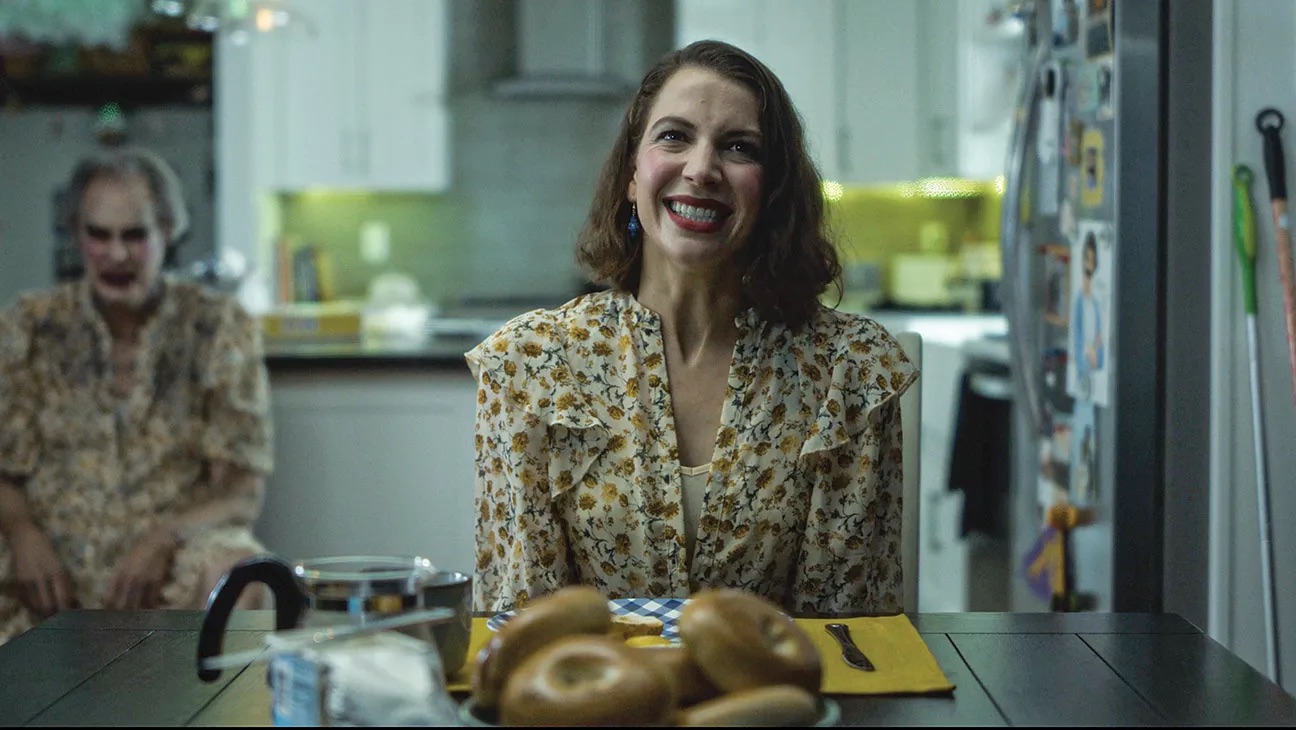
The next morning, Reese asks his girlfriend if she remembers seeing an old man the night before. She replies, “Dead Man Franklin? He comes with the chair!” Dead Man Franklin then appears out of the hallway wearing the same clothes as Reese’s girlfriend and talking in unison with her. When he stops, the conversation returns to normal, except Reese still sees him sitting in the chair.
This is the only hallucination that starts from normal day-to-day life and returns to normal conversation at its conclusion. This fluidity is especially daunting because it means all normal situations are no longer safe. The hallucinations can appear at any time.
This rule is later put into play in the cop scene when one cop threatens Reese at gunpoint for no reason and again when they are searching his house while his girlfriend is loudly masturbating in the bathroom.
The hallucination scenes remove all trust the audience has in reality, which is extremely powerful but can become overused quickly. When a director is able to toe the line correctly, this functions as a powerful method of confusing the audience.
In the final scene, Dead Man Franklin explains that a chemical released in the brain before death is responsible for both the hallucinations and the time jumps. This is consistent with the revelation of Reese having Alzheimer’s in the breakfast hallucination and gives a realistic source to the two engines of horror in the piece.
Conclusion
This combination of both methods of disorientation being used at once in the final scene creates the most hectic environment of the entire film. Reese is transported ahead in time yet again, and the audience is unsure of whether any of what they are seeing is real.
This fast escalation of discomfort and disorientation is paced like a sprint, building early and remaining heightened through the rest of the movie. This allows the movie to convey a strong sense of existential confusion and dread despite its short runtime.